
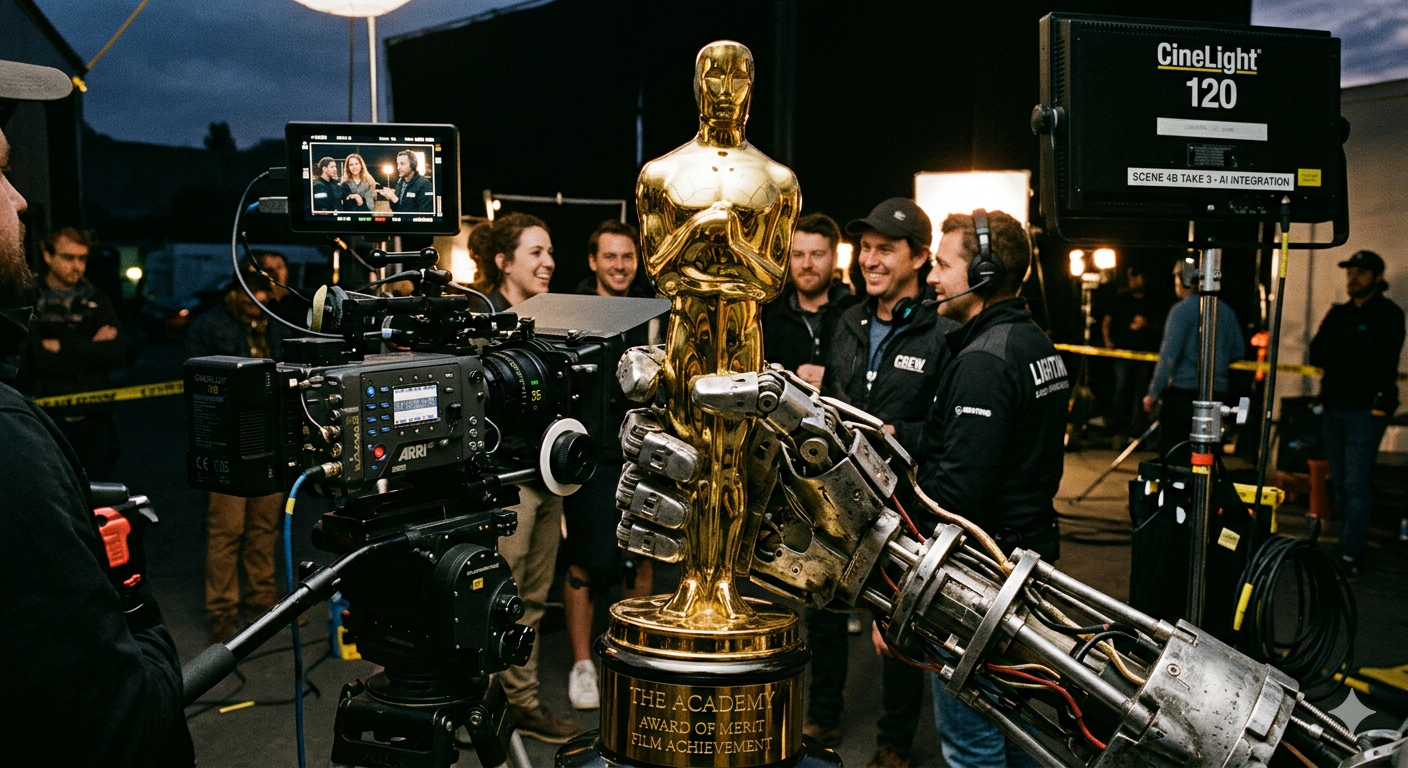
The film industry is debating AI in filmmaking, but there is still no clear way to document how AI tools were actually used.
Each year the Academy Awards celebrate the best achievements in filmmaking. The usual debates revolve around performances, directing, cinematography, and the perennial question of which film deserved to win.
Recently, however, another question has begun to appear in conversations about film production:
How much artificial intelligence helped create the films being nominated?
AI tools are now present in many parts of the filmmaking process. They assist with visual effects, sound processing, editing workflows, and other production tasks that were once done entirely by hand. These tools are rarely marketed as “AI filmmaking,” but machine learning has quietly become part of the software stack used by modern film studios.
Inside the industry, this is not particularly controversial. New tools have always been adopted as filmmaking technology evolves. Digital editing replaced physical film cutting. Computer-generated imagery transformed visual effects. Machine learning is simply the latest step in that progression.
The controversy appears later, when people try to answer a seemingly simple question.
How much of the final work came from humans, and how much came from machines?
AI is already part of the production pipeline
Modern film production relies on a wide range of specialized tools. Over the past few years, many of those tools have incorporated machine learning techniques.
Visual effects teams use machine learning systems for tasks such as rotoscoping, compositing, and generating or refining digital environments. Editors increasingly rely on automated tools to help organize footage and identify usable takes. Audio engineers use AI-assisted systems to isolate dialogue, reduce noise, and clean up recordings.
These tools are not replacing filmmakers. They are assisting them. Directors, editors, designers, and artists still make the creative decisions that shape the final film.
But once automated systems are involved in the workflow, it becomes difficult to describe exactly how a film was produced without explaining the role those systems played.
The question nobody can easily answer
As AI tools become more common in production pipelines, new questions are emerging.
Was AI used in producing the work?
What role did automated systems play in the process?
Who reviewed and approved the final result?
These questions appear not only in filmmaking but in many creative and technical industries. Publishers ask authors about the use of generative AI in manuscripts. Software companies document the use of AI tools in development workflows. Researchers increasingly disclose AI assistance in preparing academic papers.
But most creative workflows do not produce a clear record explaining how AI tools were used.
When debates arise about AI involvement in a particular work, the discussion usually takes place without reliable documentation.
The missing piece: provenance
The real issue may not be how much AI was used. The real issue may be the absence of a consistent way to record how AI tools were involved in producing a work.
In other industries, provenance records are common. Supply chains track the origin of materials and products. Scientific research records experimental methods and sources of data. Manufacturing systems document production processes.
Creative industries have rarely needed this kind of documentation. A film or book was generally assumed to be the work of identifiable human creators.
As AI systems become more deeply integrated into creative workflows, that assumption becomes harder to maintain.
Instead of debating abstractly about whether AI was involved, organizations may eventually need to document the role automated systems played in producing a work.
A broader shift
The questions surrounding AI in filmmaking are not unique to the film industry.
Writers, designers, software developers, journalists, and researchers are all incorporating AI tools into their work. As that happens, the same practical questions continue to appear:
How was AI used in producing this work?
Who exercised creative control?
Who approved the final result?
These questions are difficult to answer unless the process that produced the work was documented.
The future of creative documentation
The Oscars debate reflects a broader shift that is unfolding across many industries.
Artificial intelligence is becoming a routine part of creative and technical workflows. The question is no longer whether AI tools will be used. The question is how their use should be documented and communicated.
As AI-assisted work becomes more common, recording the origin and development of creative work may become just as important as the work itself.
Not because machines are replacing human creativity, but because the modern creative process increasingly combines human judgment with automated tools.
Understanding that process—and documenting it clearly—may become an essential part of how creative work is evaluated in the years ahead.
Leave a Reply
You must be logged in to post a comment.